Agentic Threat Intelligence Operations for Enterprise Security Teams

Turn threat intelligence into environment-specific decisions with coordinated AI agents that research, analyze, correlate, and assess intelligence across your security environment, under human oversight.

Bricklayer is an agentic cybersecurity platform for security teams that need to move beyond consuming threat intelligence to acting on it. Agents perform multi-step research and analysis across intelligence sources, enterprise information, and security tools while preserving the investigative context generated along the way. Procedures, access, agent activity, and evidence remain governed and auditable by your team.

Threat intelligence is everywhere. Actionable intelligence is not.

Security teams have access to more threat intelligence than ever. Commercial feeds, open-source intelligence, research reports, vulnerability intelligence, and internal security data all contribute to understanding the threat landscape.

The harder problem is determining what matters to a specific environment and what should happen next.

A threat intelligence investigation can involve researching an adversary across multiple sources, analyzing infrastructure and techniques, assessing relevant vulnerabilities, comparing findings against internal intelligence and the organization’s environment, and translating the results into a decision or recommendation.

These steps are related, but they often happen across different tools, sources, and workflows. The analyst is left to connect the information, carry context from one step to the next, reconcile findings, and determine what to investigate next.

Agentic threat intelligence changes that model by allowing AI agents to coordinate the investigative work while humans remain responsible for objectives, authority, and consequential decisions.

What is agentic threat intelligence?

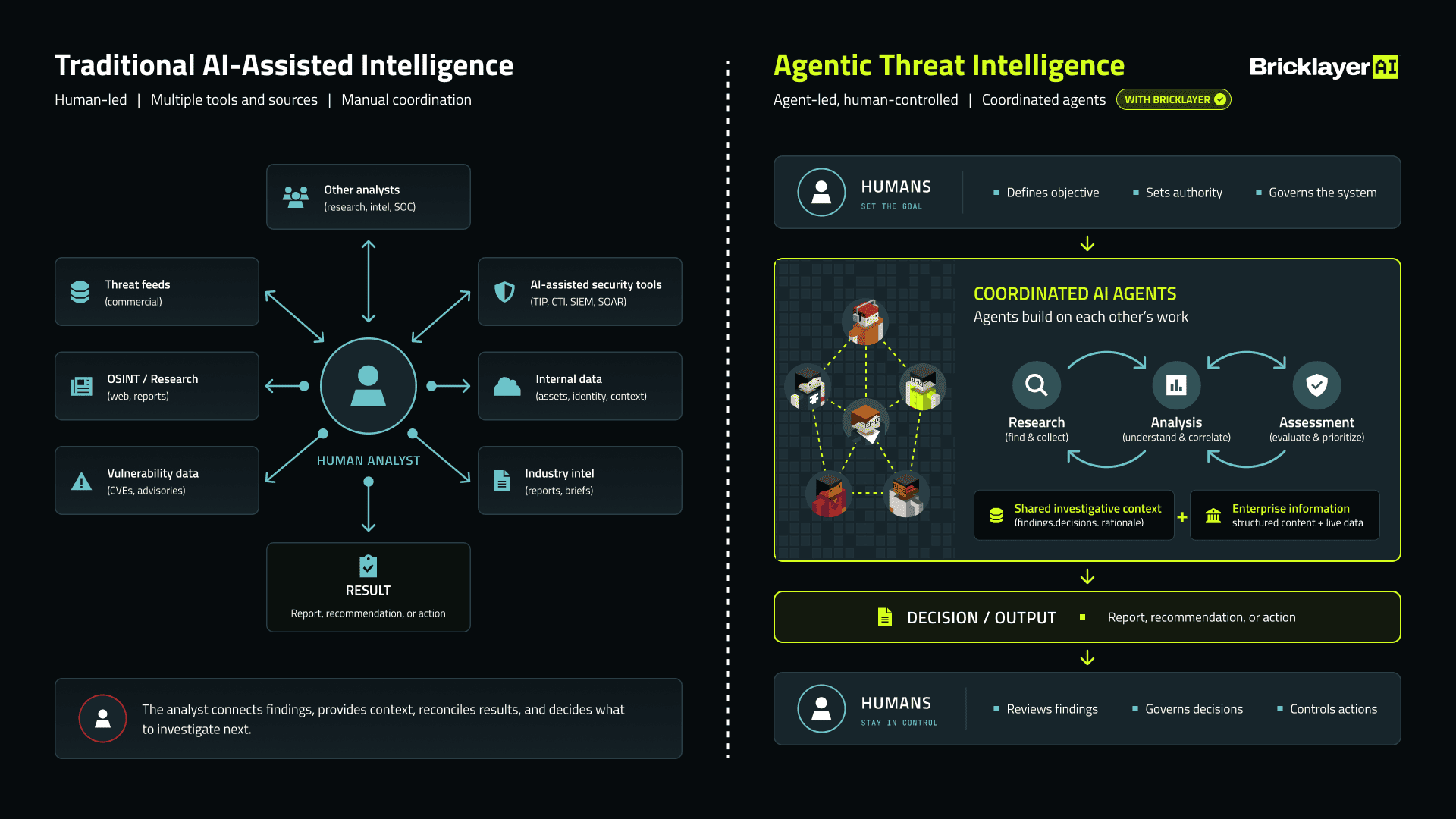
Agentic threat intelligence is a model where AI agents coordinate the multi-step work of a threat intelligence investigation toward a defined objective.

Agents can research an adversary, analyze infrastructure and techniques, correlate findings across sources, assess relevant vulnerabilities, and compare intelligence against the organization’s environment. Findings from one stage can provide context for the next rather than requiring an analyst to manually re-enter or re-explain what has already been established.

This is different from AI-assisted intelligence, such as co-pilots, where a human analyst remains the coordination layer. The analyst moves between sources and AI tools, decides what to investigate, provides context, reconciles results, and determines what happens next while AI assists with individual tasks.

In agentic threat intelligence, the coordination itself moves from the individual analyst to the AI workforce.

Humans define the objective, establish the boundaries for agent activity and access, and govern the findings, decisions, and actions that matter.

From intelligence to decision

Threat intelligence is most useful when the work extends beyond retrieving or summarizing information. Bricklayer agents can perform investigative workflows that connect intelligence to the decisions security teams need to make.

Topical Research

Investigate a threat, technology, vulnerability, campaign, sector, or emerging development across relevant intelligence sources. Agents can gather and synthesize information into structured findings that provide a starting point for deeper investigation.

Threat Actor Analysis

Investigate adversaries, infrastructure, tactics, techniques, indicators, campaigns, and known relationships across intelligence sources. Agents can correlate related information to develop a more complete understanding of the threat and its relevance to the organization.

Situational Awareness

Combine external intelligence with internal asset, identity, exposure, and security data to determine what is relevant to your organization. Instead of assessing a threat only in the context of the broader threat landscape, agents can evaluate it against the systems, exposures, and conditions that exist in your environment.

CVE / Vulnerability Analysis

Investigate vulnerabilities in the context of your environment, including affected assets, exposure, and other relevant security data. Agents can connect vulnerability intelligence to environmental context to help determine relevance and priority.

These activities can run as individual workflows or be chained together as part of a broader investigation. A threat actor investigation can inform vulnerability analysis. Vulnerability findings can contribute to situational awareness. Research findings can provide context for subsequent analysis without requiring each stage to start from zero.

What makes multi-agent threat intelligence work?

A single AI interaction can produce an answer without needing to preserve much history. A multi-agent investigation is different.

Research generates findings. Analysis builds on those findings. Other agents add context or test a conclusion. The eventual decision depends on information accumulated across the investigation.

If that information is passed between agents as disposable text or isolated task outputs, important context can be lost, duplicated, or reinterpreted at each handoff.

Bricklayer addresses this through Multi-Agent Context Engineering (MACE), an architecture for creating, structuring, and governing context across collaborative work involving multiple agents, procedures, and sources of enterprise information.

For threat intelligence, MACE addresses three requirements.

Investigative context that carries forward

Agents need more than the final answer from a previous step. They need access to the findings, observations, decisions, and recommendations that provide context for the work that follows.

Bricklayer preserves this investigative knowledge as structured Insights, which can be organized into Insight Groups that maintain the context of a specific investigation or task. This allows subsequent agents to build on relevant findings from earlier stages without requiring the entire investigation to be passed from one task to the next.

Enterprise content that keeps its structure

Agents also need the enterprise information on which investigations depend. A threat intelligence report, vulnerability dataset, incident timeline, table, or JSON object has its own structure and meaning.

Bricklayer’s Typed Content Architecture preserves that structure rather than flattening enterprise content into generic text. Agents can work from the same structured information instead of each creating a temporary representation.

Persistent access to underlying data

Some information is too large, dynamic, or interconnected to treat as temporary input to an individual agent.

Bricklayer’s Agent-Native Data Plane gives agents persistent, governed access to underlying enterprise data. Agents can query, filter, aggregate, correlate, and transform data in place, bringing only the information relevant to the task into their working context.

Multiple agents can work against the same underlying data while contributing investigative knowledge on top of it.

Together, these capabilities allow an investigation to accumulate context instead of reconstructing it at every handoff.

How Bricklayer works in a threat intelligence workflow

This example shows how a chained Bricklayer investigation moves from an intelligence objective through multiple agents, sources, and stages of analysis while structuring and preserving the context and evidence generated along the way.

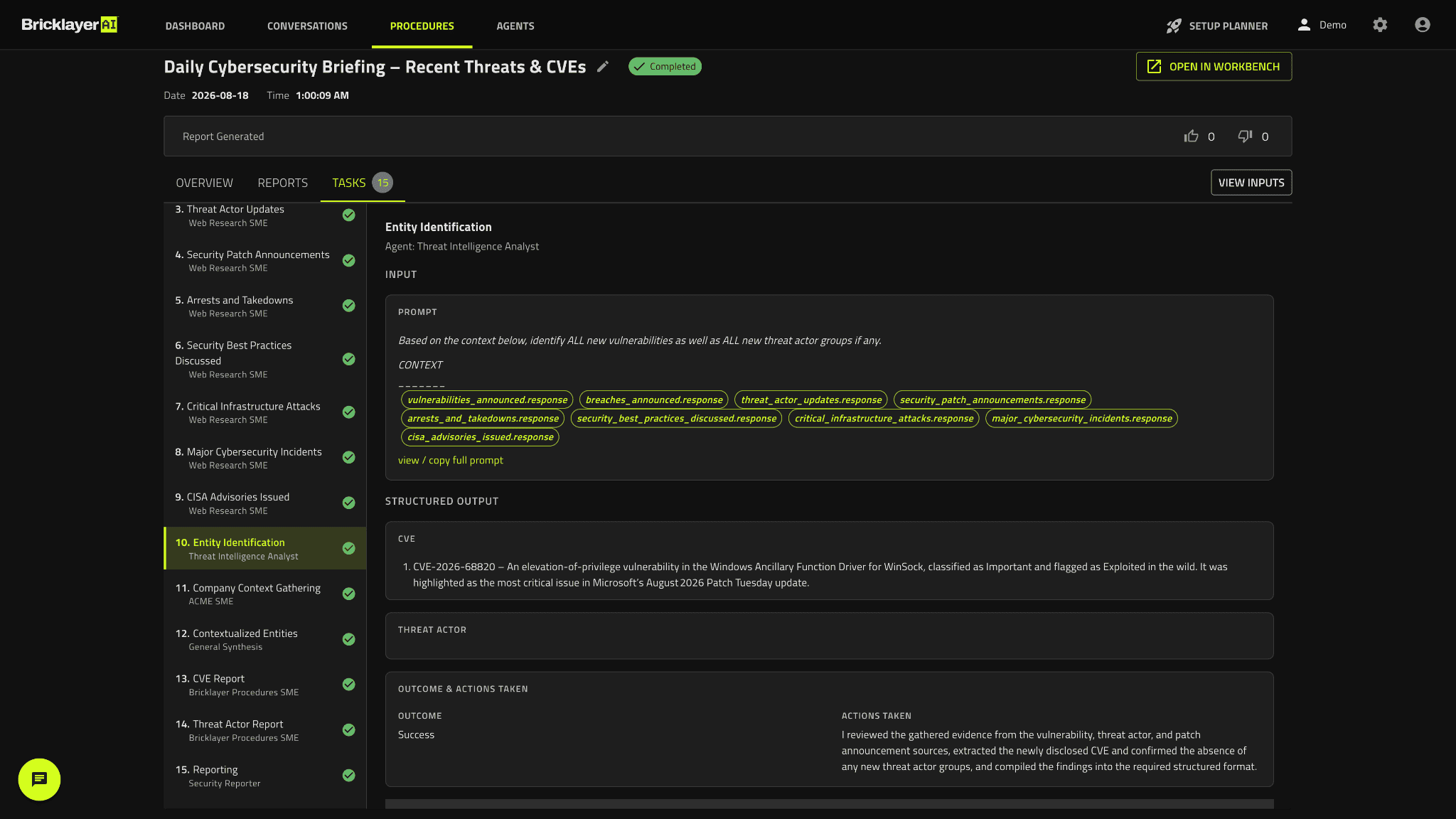
This agentic threat intelligence workflow starts by gathering what changed over the past day across the threat landscape. Coordinated agents research vulnerabilities, breaches, threat actors, security patches, arrests and takedowns, security guidance, critical infrastructure attacks, major incidents, and CISA advisories published across public and private intelligence sources. 

Those findings are preserved as structured investigative context, allowing subsequent agents to identify new vulnerabilities and threat actors and then evaluate them against the organization’s specific environment, including its industry, products, technologies, and assets. From there, specialized procedures can investigate the threats that are relevant to the organization and produce detailed reports with supporting evidence. 

The workflow culminates in an environment-specific executive summary that distinguishes what happened from what actually matters to the organization, including the vulnerabilities, threats, and recommended actions that should be prioritized for the day.

AI agents work within your rules

Agentic threat intelligence does not mean giving AI unrestricted authority over security operations.

Governance has to extend beyond model selection. Security teams need to control what agents are authorized to do, what information and systems they can access, which procedures they follow, and when human review is required.

Bricklayer provides control through:

Defined procedures
Define how recurring intelligence workflows are performed, what agents are authorized to do, and who can run them.

Scoped access
Control the sources, tools, systems, and internal data available to each agent. Access is explicitly defined rather than assumed.

Role-based access control (RBAC)

Control who can create, modify, run, and review procedures and agent workflows based on their role.

Human review checkpoints
Define anywhere human review is required before an agent proceeds, such as before a finding is escalated, a report is delivered to a stakeholder, or an action is taken in a downstream system.

Auditability
Maintain full visibility into agent activity, investigative context, supporting evidence, and the work performed throughout the investigation.

The objective is not to remove humans from the process. It is to move them out of manually coordinating every investigative step while retaining control over objectives, authority, decisions, and outcomes.
Evidence that survives the handoff

An agent’s conclusion should not become a black box when work moves to another agent.

Bricklayer preserves the investigative context and enterprise information behind the work so downstream agents and analysts can understand not only what was concluded, but what the conclusion was built on.

A threat intelligence finding can carry its supporting context into the next stage. A vulnerability agent can work against the same underlying asset data. A downstream workflow can use relevant findings without restarting the investigation.

This creates a traceable chain from intelligence to analysis to decision.

From intelligence to action

Threat intelligence becomes more valuable when the work does not end with a report.

Because Bricklayer coordinates agents across security workflows, intelligence can become part of operational work rather than remaining isolated in an intelligence platform or report.

Environment-specific assessment can help determine where security teams should focus. A finding about an adversary can inform threat hunting. Intelligence about a vulnerability can feed vulnerability management. Evidence gathered during research can support an incident investigation.

The same underlying context and enterprise information can support the next stage of work, performed by an agentic system, without requiring the investigation to be repeated.

Proof in operational use

Bricklayer is being used to perform threat intelligence operations in production. Customers have realized:

85%+ faster threat intelligence investigations

400+ members receiving AI-curated intelligence daily

550+ analyst hours saved in the first 30 days


These results illustrate the operational value of moving beyond AI-assisted individual tasks to coordinated investigative work across intelligence sources and the broader security environment.

Bricklayer also powers intelligence-driven security operations for the Arizona Cyber Threat Response Alliance (ACTRA), helping bring intelligence into operational workflows and connect external threat information with the environments where security teams need to act.

Turn threat intelligence into decisions

See how coordinated AI agents can perform threat intelligence work across your environment while your team stays in control.

Frequently Asked Questions

An agentic threat intelligence platform uses AI agents to perform and coordinate multi-step intelligence work, including research, analysis, correlation, and relevance assessment, toward a defined objective. Agents build on the work of other agents rather than treating every task as an isolated query.

Individual AI tools can assist with tasks such as summarizing a report or answering a question. Agentic threat intelligence coordinates a broader investigation across multiple steps and sources, with agents handling the coordination while humans define objectives, authority, and boundaries.

Bricklayer agents evaluate external intelligence against your organization’s specific environment, assets, exposures, and other security data. Findings can then inform decisions and downstream workflows such as threat hunting, vulnerability management, and incident investigation.

It means your team defines what agents are authorized to do, controls what information and systems they can access, establishes where human review is required, and maintains visibility into agent activity and the evidence supporting the work.

Bricklayer agents coordinate investigative steps toward a shared objective. They can contribute findings, build on structured investigative context, work with structured enterprise content, and access relevant underlying enterprise data within defined controls.

Yes. Threat intelligence findings can inform threat hunting, vulnerability management, incident investigation, and other security operations workflows using the same coordinated agents, investigative context, and underlying enterprise information.

MACE is Bricklayer’s approach to creating and structuring, and governing context across collaborative work involving multiple AI agents. It enables agents to build on prior investigative work, work with enterprise information in its native structure, and access the underlying data they need without reconstructing the investigation at every step.

Bricklayer preserves structured investigative findings and the enterprise information behind them so that relevant context can carry from one stage of an investigation to the next. Agents can reference prior findings, work from structured enterprise content, and query underlying enterprise data without requiring the entire investigation to be passed between tasks.

NC
Neil Cohen

Neil is a 4X marketing leader with 20+ years of go-to-market, product, and general management experience across cybersecurity and B2B technology, driving growth and product strategy.

Last Updated: October 14th, 2026

Build an Agentic SOC Without Sacrificing Control

Your team stays in control. Your threats get handled at scale. See it live in 30 minutes.

Book a Demo →