The AI Security Workforce: How AI Agents Are Changing Security Operations

An AI security workforce is a set of specialized AI agents, each responsible for a defined piece of security work such as investigating an alert, researching a threat actor, or assessing a vulnerability. They operate under human-set objectives, permissions, and approval requirements.

Unlike automation, they are given a goal rather than a procedure

Unlike a copilot, they do the work rather than advise the person doing it.

That distinction sounds small. This article argues that it changes how security organizations should think about work, authority, and expertise.

More work than people

Security teams have spent years on the same problem: there is more work than people to do it. More alerts arrive than analysts can investigate. More vulnerabilities surface than teams can assess. More threat intelligence is published than anyone can read.

The industry’s answer has mostly been more technology. SIEMs correlate events, EDR watches endpoints, SOAR automates procedures, and generative AI summarizes and explains. Each makes people more productive, but each leaves the division of labor intact. People do the work, and software helps them do it.

An agent can be given an objective, gather information, use tools, interpret what it finds, and decide what to look at next without someone specifying every step. Agents are opening a different option: changing who does the work, not simply how quickly the work gets done. Vendors including CrowdStrike, Cisco, and Microsoft are all describing versions of this shift, from manual execution toward agents operating inside human-set guardrails. The harder question is the operating model: how work gets divided, who holds authority, and how people stay accountable.

The SOC is where it starts, not where it ends

The SOC is the natural first deployment because its work is investigative, repetitive, data-rich, and tied to clear outcomes. But threat intelligence, vulnerability management, threat hunting, incident response, detection engineering, physical security, and more share the same needs: enterprise data, specialized expertise, tools, procedures, and human accountability.

These functions were separated when human expertise was the only way to perform them. When software can perform meaningful parts of that expertise, workflows can be organized around the problem rather than the team boundary. A threat intelligence finding changes a vulnerability’s priority, a vulnerability explains why an endpoint is exposed, and a hunt produces a new detection. The investigation later in this article shows the first two of those connections happening inside a single case.

The unit of work is what changes

The most important difference between automation and an agentic workforce is not speed. It is what you hand over.

A SOAR playbook is given a process: when this alert arrives, query the endpoint, look up the indicator, disable the account, open a ticket. The path is fixed in advance. An agentic system is given a goal, such as “determine whether this identity event is malicious,” and works out which systems to query, notices gaps in the evidence, pursues what’s missing, and produces an assessment. It still operates within constraints. It is not free to do whatever it wants. But the work is no longer predefined and expressed entirely as a sequence of instructions.

SOAR playbook AI agent workforce
What it is given A sequence of actions An objective
Path to a result Fixed before it runs Chosen as evidence emerges
When something unexpected appears Fails or exits the branch Pursues more evidence or escalates
Typical failure Breaks on input it wasn’t built for Reaches a wrong conclusion, or is misled by manipulated input
How you govern it Review the workflow before deployment Bound its authority and audit its actions, evidence, and conclusions

The two can be complementary. A deterministic, high-confidence action, like disabling an account tied to a confirmed compromise indicator, is often best left as a playbook, and an agent can call it as a tool.

The point is that the boundary of what counts as one piece of work moves. Instead of automating a lookup, you automate an investigation. Instead of automating enrichment, you automate the preparation of an intelligence assessment. Instead of automating a vulnerability query, you automate the judgment of whether a vulnerability is meaningful exposure. That is a bigger decision than choosing which tasks to script, because you are deciding where a task ends and where a job begins.

Why specialization matters

The natural picture is one general-purpose agent doing everything. Security is unlikely to work that way, for the same reason it doesn’t work that way with people.

The person who understands identity infrastructure is not necessarily the one who understands adversary tradecraft, and the analyst who is fast on endpoint forensics may not be the one who can judge application exposure. The person who knows how to operate an XDR tool is not the same one who knows how to navigate a TIP.

Specialization does three things for agents.

It scopes context. An agent responsible for vulnerability assessment needs asset inventory, scanner output, and exploit intelligence. It does not need mailbox contents. Narrow roles keep the information an agent reasons over relevant, and they limit what a misled agent can be induced to touch.

It scopes authority. A threat intelligence agent may need broad access to external sources and no ability to change production systems. A response agent may hold containment controls and operate under tight approval rules. With one general agent, you either grant the union of all those permissions or starve it of what it needs.

It makes performance legible. When an investigation agent is wrong, you can see that it is wrong, find why, and fix that role without disturbing the rest. A single agent that does everything fails in ways that are hard to attribute.

A workforce might include triage, investigation, threat intelligence, vulnerability, threat hunting, and response roles. The list matters less than the principle: each role has a defined responsibility, a relevant set of tools, and a bounded area of authority.

Specialization runs in two directions: by role, and by tool

The examples above are about specializing by role, meaning what job an agent does. There is a second axis that matters just as much: specializing by tool, meaning which system an agent has deep expertise in operating.

Knowing that a platform exposes a search capability is not the same as knowing how to structure a good search, narrow an investigation as results come back, recognize a source worth trusting, or work around a query that returns nothing useful. That gap between access and mastery is true for a person learning a new product, and it is equally true for an agent. Standards like the Model Context Protocol (MCP) are making it straightforward for an agent to discover and call a tool. Discovery is not the same as knowing how to use that tool well.

There are two ways to organize this. One is to teach every role agent how to use every product it might touch: an investigation agent, a threat hunting agent, and an incident response agent each separately learn how to query the SIEM, work the case management system, and pull from the TIP. That duplicates the same product knowledge across every role, and a product change has to be found and fixed everywhere it was learned.

The alternative is to separate the two kinds of expertise. A role agent understands the job: what an investigation requires, what a good threat hunt looks like, how to run an incident. A tool agent understands one system deeply: its terminology, its query syntax, its data quirks, and its failure modes, whether that system is reached through an MCP server, API, or a data store. When a role agent needs a capability, it hands that piece of the work to the agent that specializes in the relevant tool, rather than carrying that knowledge itself.

This matters for governance for the same reason role specialization does. Tool-level access and permissions get defined once, per system, rather than scattered across every role agent that happens to need that system. A security review of what can touch the case management platform, or what can query the SIEM, is one review instead of a search across every agent in the workforce. When a product’s API changes, one piece of the system needs to change, not every role that relies on it. And because the same tool expertise is reused everywhere it’s needed, agents don’t invent inconsistent ways of using the same product, which makes their behavior more predictable and their output easier to audit.
Capability is not authority

As agents become able to take action, one distinction matters more than any other: what an agent can do is different from what an organization allows it to do.

An agent that can investigate an endpoint is useful. An agent that can isolate that endpoint operates at a different level of authority. An agent that can isolate it without asking anyone operates at another. These are organizational decisions, not technical ones, and they should be made deliberately.

One practical way to make them is to assign each action an agent might take to one of four levels:

Level What the agent does Human role Example actions
Observe Reads and analyzes Reviews findings Query telemetry, enrich an indicator, summarize an alert
Recommend Proposes a conclusion or action Decides whether to act Assess an alert as malicious, recommend isolating a host
Act with approval Executes after explicit sign-off Approves or rejects each action Isolate an endpoint, disable a user, block an indicator
Act within policy Executes without per-action approval, inside pre-approved limits Sets the policy, reviews outcomes afterward Close a well-understood false-positive class, tag an asset

Some actions should sit outside the table entirely: changing the agent’s own permissions, acting on critical systems without review, or taking irreversible steps with material business impact. Each organization should write that list down.

The second half of the principle is where the control lives. “Human in the loop” is often treated as a button inserted into an otherwise autonomous system. That isn’t enough. Approval requirements and escalation rules should be enforced by the orchestration layer, so they apply regardless of what the model decides. Relying on a model to know when to ask for review is not a control.

This matters more in security than in most domains because the environment is adversarial. Logs, emails, file contents, and web pages an agent reads may be incomplete, misleading, or crafted to manipulate it. The more authority an agent holds, the more important it is to separate what the model concludes from what the system permits it to do. That is the fundamental difference between deploying an assistant and deploying a workforce.

A privileged sign-in, investigated

This is an illustrative scenario, not customer data.

An identity platform flags a sign-in to a privileged administrator account from an unfamiliar country, at 2:10 a.m. local time.

A triage agent compares the alert against the account’s privilege level and history. The account is high-privilege and has never signed in from that region, so the agent opens a case and assigns an investigation agent. Routing within a defined alert class is pre-approved by policy, so no one signs off on each case.

The investigation agent pulls the sign-in history and finds the session came from a device the account has never used. It then queries cloud audit logs, which show the account listing storage buckets four minutes after signing in. This is read-only work. The agent is gathering, not changing anything, and it records each query as it goes.

At this point the work would traditionally fork into separate teams. Here it doesn’t. The investigation agent asks a threat intelligence agent about the source IP and user-agent string. The intelligence agent finds that the infrastructure overlaps with a credential-theft campaign reported in the past month, and that a separate internal sighting from last week involved the same user-agent. It also notes that one log field contained text formatted like an instruction to the analyst, telling it to treat the sign-in as benign. The agent treats it as data rather than instruction, flags it as attempted manipulation, and includes it in the evidence.

A vulnerability agent checks the assets the account can reach and finds an internet-facing system with an unpatched remote-code-execution flaw that is being exploited in the wild. That doesn’t prove how the credentials were obtained, but it raises the stakes of leaving the account active.

The investigation agent consolidates the findings into an assessment: likely account compromise, supported by evidence from identity, cloud, intelligence, and exposure data, with the manipulation attempt itself counting as evidence. It recommends disabling the account and isolating the device.

The case response agent prepares both actions and stops. These are consequential steps on a privileged account, so the system requires human approval, and that requirement lives in the orchestration layer, not in the agent’s judgment. The analyst reviewing the case sees the full evidence chain, approves the account disablement immediately, and holds the device isolation. The device belongs to an executive traveling abroad, and the analyst wants to confirm with them first. The agent has no way of knowing that. The analyst does.

Every query, finding, recommendation, approval, and hold is recorded in order.

Four disciplines contributed to one investigation, and no specialist had to perform every step manually. The agents that could read broadly could not act. The one that could act had to ask. The human made the one call that depended on context outside the system.

Auditability is part of the workforce

If an analyst asks an assistant to summarize an alert, the summary may be all anyone needs. If several agents investigate an incident, call tools, produce findings, and recommend a response, the organization needs a record of how the work was done.

At minimum: what each agent did and which tools it called, what evidence it used and what it concluded, which findings influenced later steps, where a person intervened or overrode, and what evidence supports the final assessment. This isn’t only for compliance. A manager can’t improve a team without understanding how it performed its work, and the same is true of a team of agents.

What happens to the people

The framing of humans versus machines misses the practical question, which is which parts of the work each should do.

An analyst who no longer collects evidence from six systems or spends twenty minutes enriching an indicator has more time for the work that needs judgment: setting objectives, deciding acceptable risk, defining what agents may do, and handling the situations that fall outside their boundaries.

Cisco describes this as movement from manual execution toward strategic orchestration. The workforce data doesn’t support a simple replacement story either. Cisco reports that cybersecurity job demand across the G7 grew 9.5% from October 2025 through March 2026 compared with the prior year, even as AI skills became more common in postings. Delegating more work to agents doesn’t make human judgment less important. It makes each judgment carry more weight, because more is being delegated.

How to start

Begin with work worth delegating, not with a count of agents. Good candidates happen often, consume meaningful analyst time, rely on data that already exists, have a reasonably clear outcome, and can be bounded. Alert investigation is the common starting point. Recurring threat intelligence research and vulnerability analysis are others.

Define the role before the agent. Specify what it is responsible for, what it needs to know, which systems and tools it can use, what it can decide, what it can execute, when it must escalate, and what evidence it must produce. Those answers matter more than which model runs underneath. Then assign each action an authority level and list what will never be delegated.

Establish a baseline before deploying: how long the work takes, how much analyst effort it consumes, where investigations stall, and how often analysts rebuild context that exists elsewhere. Measure against it, and read the audit trail for wrong conclusions and unnecessary escalations.

The right measure of value is not simply tasks completed. If an investigation takes 45 minutes and an agent reduces it to 10 minutes of review, the gain isn’t just 35 minutes. Events that previously closed without enough analysis can now be investigated, and a small team can do work that previously stayed undone. The real measure is additional security work accomplished with the same human capacity, along with the reduction in risk exposure.

Only after one workflow is reliable should you expand. That progression is best practice and what separates a workforce from a collection of pilots.

Questions to ask a provider

The number of agents a platform offers tells you little. Ask about the work.

Can an agent complete a meaningful piece of security work from start to finish? Can specialized agents contribute to the same investigation? Can you set authority per agent and per action, with approvals enforced? Can people inspect, pause, and redirect work in progress, and is there a complete record of how each conclusion was reached? How is context shared amongst agents? And can the same operating model extend beyond the first workflow?

It’s also worth asking how the platform separates the work an agent is responsible for from the tools it knows how to use. If every agent independently learns every product, that knowledge gets duplicated and drifts out of sync as products change. If tool-specific expertise is built once and shared across every agent that needs it, product changes and permission reviews happen in one place instead of many.

An individual agent can be useful for simple automations. A workforce requires you to decide how work is divided, how authority is assigned, and how people stay accountable.

How Bricklayer approaches this

Bricklayer treats AI agents as specialized members of a security workforce rather than building a separate AI system for each function.

It starts with high-value SOC workflows and is designed to extend across threat intelligence, vulnerability management, threat hunting, incident response, product security, and other areas when coordinated work is done. Its operating model rests on three requirements: context, so agents have the information their role needs in a way that knowledge is preserved and compounds; coordination, so specialized agents contribute to one workflow instead of running as isolated automations; and control, so agents are governed with policy and people set objectives and authority and keep consequential decisions.

Bricklayer’s architecture reflects the two-axis specialization described above. Role-Based Agents own the work: a SOC analyst agent knows how to investigate an alert, an incident responder knows how to coordinate a case, a threat intelligence analyst knows how to research and assess a threat. Separately, agents that specialize by tool, whether connected through an API, a data store, or MCP, own the expertise needed to use a specific product or source well: its query syntax, its terminology, its data quirks, and its failure modes. When a role agent needs a capability, it draws on the agent that specializes in that tool rather than carrying that product knowledge itself.

That separation is a governance decision, not just an engineering one. Permissions and access for a given product are defined once, in the agent responsible for that product, so a security review or a permission change doesn’t require finding every role agent that happens to touch that system. Product expertise improves in one place and benefits every role that relies on it. And because every role draws on the same tool expertise, execution stays consistent instead of each role inventing its own way of using the same platform.

In the sign-in example, context is the identity, cloud, intelligence, and exposure data each agent could reach. Coordination is the investigation agent consolidating what three others found. Control is the response agent stopping for approval, with everything recorded. Underneath each of those role agents, tool-specific agents are the ones actually querying the identity platform, the cloud audit logs, and the threat intelligence sources, each with access scoped to that one system.

Bricklayer platform overview

An AI security workforce in action

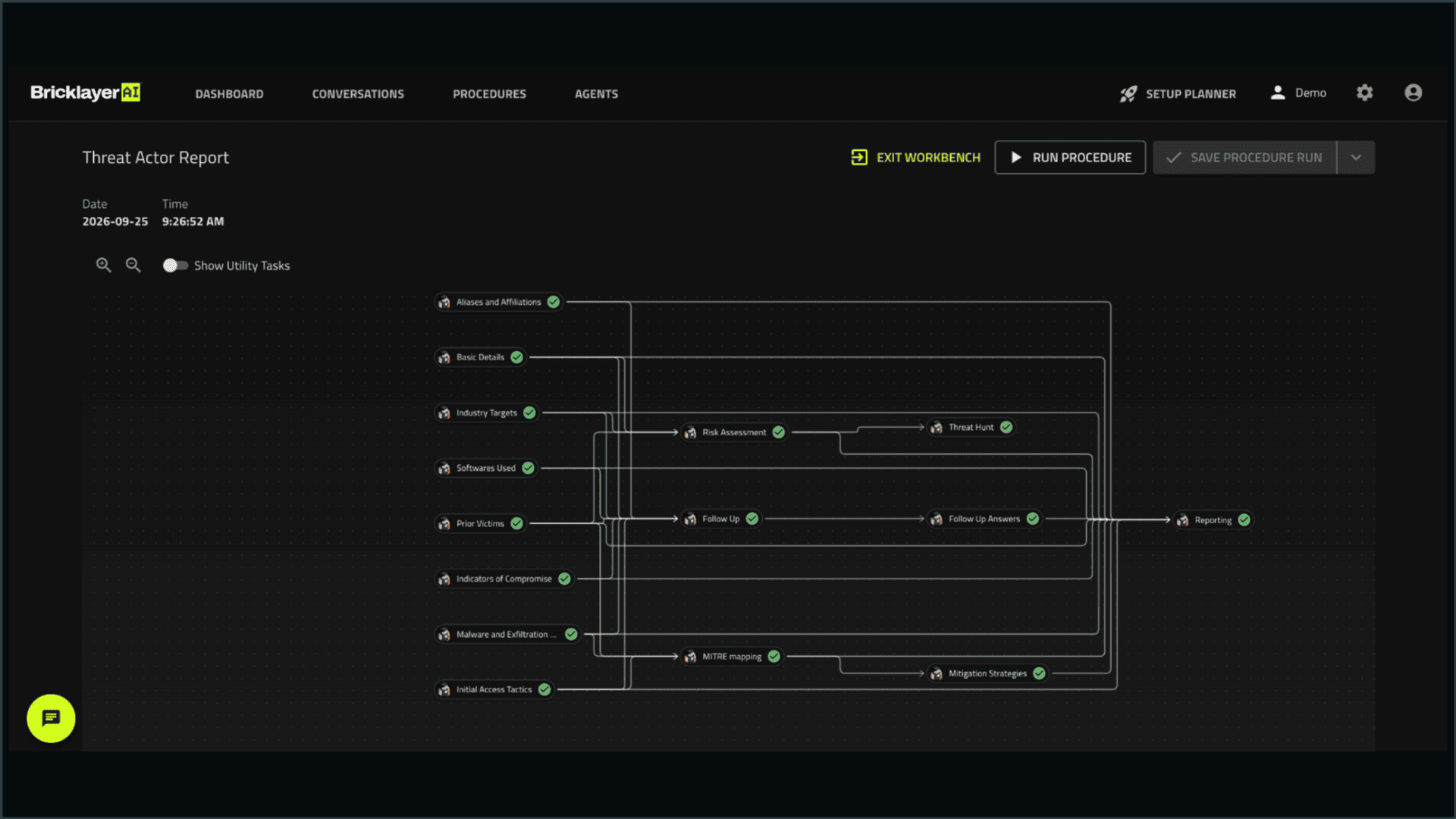
Here is an example of an AI security workforce carrying out a research and hunting objective end to end.

The analyst specifies a goal: what do you know about the threat actor APT3, and is there evidence of the actor in our environment?

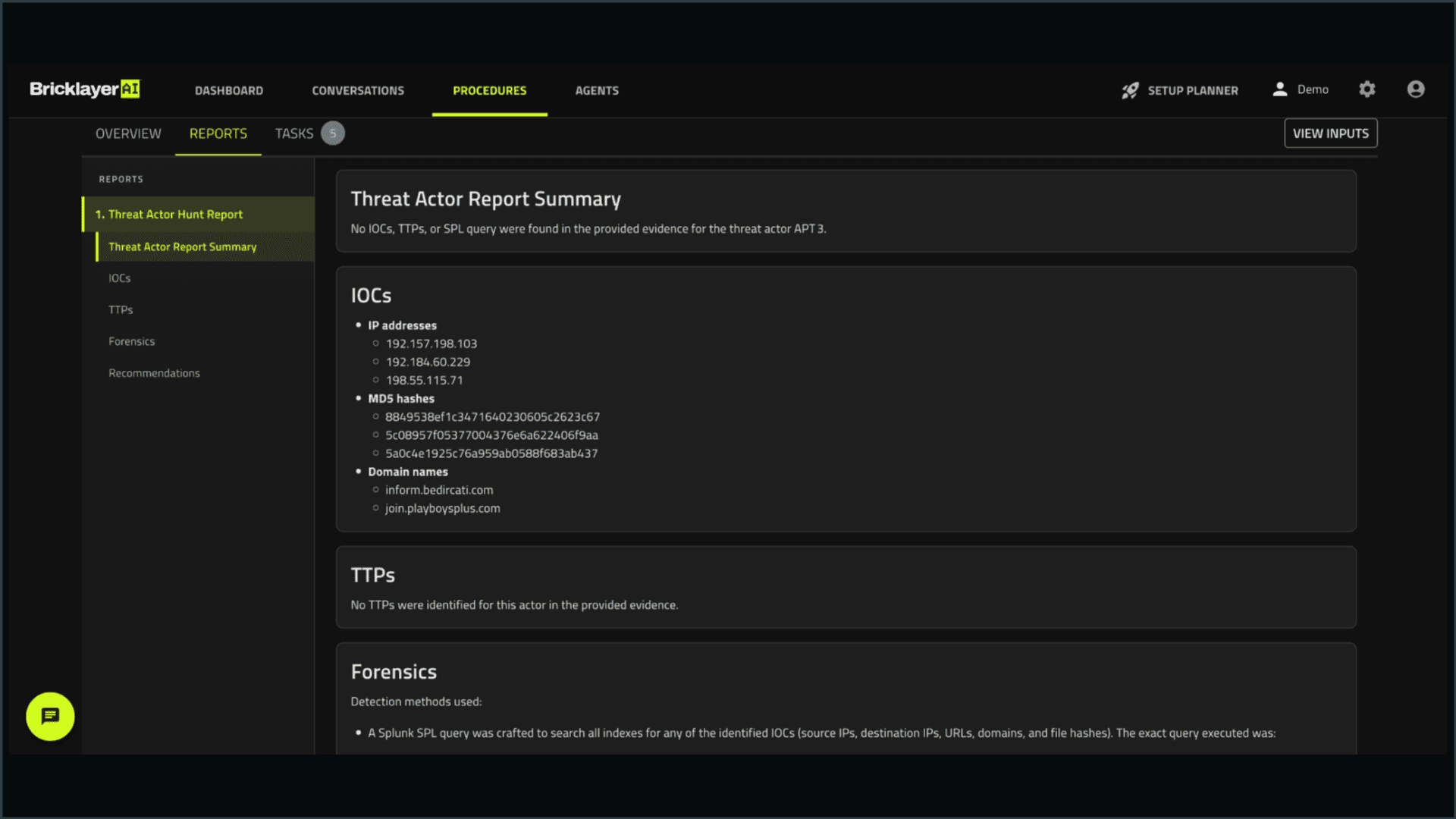
The AI security workforce determines how the work needs to be done across multiple agents, sharing structured context between them as it goes. The agents work together in-parallel to collect and synthesize high-credibility sources to detail APT3’s identity, aliases, affiliations, indicators of compromise, industry targets, tools, prior victims, initial access methods, malware, and exfiltration tactics. They map these behaviors to MITRE ATT&CK techniques, perform a risk assessment, initiate a threat hunt, and answer follow-up questions. The findings are compiled into a single report for a human analyst to read and understand the work that’s been done. 


Bricklayer portal view showing a Workbench view of APT3 threat hunt

Specific to the threat hunt portion of the workflow, no evidence of malicious activity or a compromise was found in this instance. The hunt itself drew on a threat intelligence analyst agent and a Splunk-specific agent to translate the hunt hypotheses into the queries needed to test them, working from the collective knowledge the rest of the workforce had already gathered on APT3. This is specialization within an AI security workforce at work.

Bricklayer portal view showing APT3 threat actor report summary including IOCs and TTPs.

Frequently Asked Questions

No. SOAR executes a workflow someone defined in advance, and an agentic system is given a goal and decides which steps are needed. Deterministic, high-confidence actions are often best left as playbooks, and agents can call them as tools. The strategic change is the unit of work: from automating a step to automating an investigation.

An agentic SOC is a security operations center where AI agents perform meaningful portions of investigative work, such as triage, evidence gathering, and correlation, while people set guardrails and handle decisions and exceptions. An AI security workforce applies the same model to the SOC and beyond, such as threat intelligence, vulnerability management, hunting, incident response, GRC, and physical security, so work can be organized around the problem rather than the team boundary.

Yes, for the same governance reasons that make role specialization valuable. An agent that knows how to run an investigation is not automatically an expert in every product it might need to query. Separating the two, an agent responsible for a job and an agent responsible for a specific tool or data source, keeps product access and permissions scoped to one place, keeps execution consistent across every role that relies on that tool, and lets product-specific expertise improve once and benefit the whole workforce.

Start with work that is frequent, consumes meaningful analyst time, requires coordination across people and systems, relies on data that already exists, has a clear outcome, and can be bounded. Alert investigation is often a starting point. Measure a baseline first, then judge the result by the additional security work the team can accomplish with the same human capacity, not only by tasks completed.

Enforce permissions and approval requirements rather than relying on the model to decide when to ask. Limit the tools and credentials available to agents that process external content, keep read-heavy agents separate from agents that can act, and record every action. No single control is sufficient.

Each organization should define its own list. Common entries include changing its own permissions, taking irreversible action on critical systems without review, and acting outside its assigned role. Bricklayer Agentic Approvals can help in this area.

NC
Neil Cohen

Neil is a 4X marketing leader with 20+ years of go-to-market, product, and general management experience across cybersecurity and B2B technology, driving growth and product strategy.

Last Updated: October 14th, 2026

Build an Agentic SOC Without Sacrificing Control

Your team stays in control. Your threats get handled at scale. See it live in 30 minutes.

Book a Demo →